Price mechanics
Ask, Bid, and why your alert seems early
· 4 min read
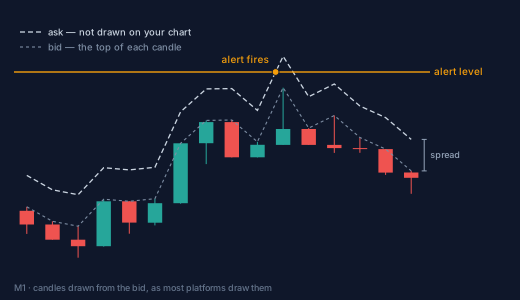
You set an alert at a level. Your phone buzzes. You open the chart, and the candle hasn't reached the line — it's sitting a pip below, clearly short of it.
Nothing is broken. The alert measured something your chart isn't drawing.
There are always two prices
At every moment a currency pair has two: the bid, what you can sell at, and the ask, what you can buy at. The ask is the higher of the two. The distance between them is the spread, and it is how the market makes its money on you being there at all.
There is no third price that is the real one. "The price of EURUSD" is shorthand, and what it's short for depends on who's speaking.
Your chart only draws one of them
Most platforms draw the bid. A few draw the mid. Almost none draw the ask.
So the ask has been there the whole time, running invisibly about a spread above every candle on your screen — above every high, every close, every wick. When your chart shows a high of 1.0850, the ask reached roughly 1.0851 in that same minute. You just weren't shown it.
An alert watching the ask therefore fires before the visible candle arrives at the line. Not early. Measuring a different line, one your chart declined to draw.
Which side to watch isn't a preference
It follows from what you would actually do there.
If the level is somewhere you'd buy, you would pay the ask — so the ask is the number that decides whether that level is reachable at all. Waiting for the bid to arrive means waiting past the point where you could have transacted.
If the level is somewhere you'd sell, the bid is the one, for the same reason in reverse.
And if you only want to know that the market visited an area, either works, and the difference is smaller than the noise you're watching for.
The spread isn't constant, and that's the part that bites
For most of the session on a major pair the gap is small and steady, and the offset between your chart and an ask alert is a pip you can carry in your head.
Then the day rolls over around 21:00 UTC, or a number prints, or Sunday evening opens — and the two lines pull apart, sometimes several times wider than normal. In those minutes a pip of "early" quietly becomes ten.
The uncomfortable part: the wider the spread, the more the two sides disagree about what happened. A wick that touched your level on one side may not exist at all on the other. Both are true. They're just true about different prices.
Candle alerts don't escape this
A touch is about a moment; a close is about a whole bar. But a bar's open, high, low and close are built from one side too. "The candle closed beyond the line" is a statement about whichever side that candle was made from.
Same question, one layer up.
The practical version
None of this needs fixing. It needs choosing:
- Pick the side you would actually transact on, not the side that makes the chart look tidy.
- Expect a small, steady offset between what you see and what an ask alert measures.
- Expect that offset to grow at rollover, around news, and at the Sunday open.
- If an alert fires and the chart looks untouched, check which side it was watching before you check anything else.
The spread isn't an error in the data or a trick played on you. It's the price of the two different things you could do at that moment — and an alert, being a single question, has to be about one of them.
This article describes how bid and ask prices work. It is not trading advice.
Batdorj Byambadorj
Batdorj Byambadorj writes from nearly twenty years of trading forex.